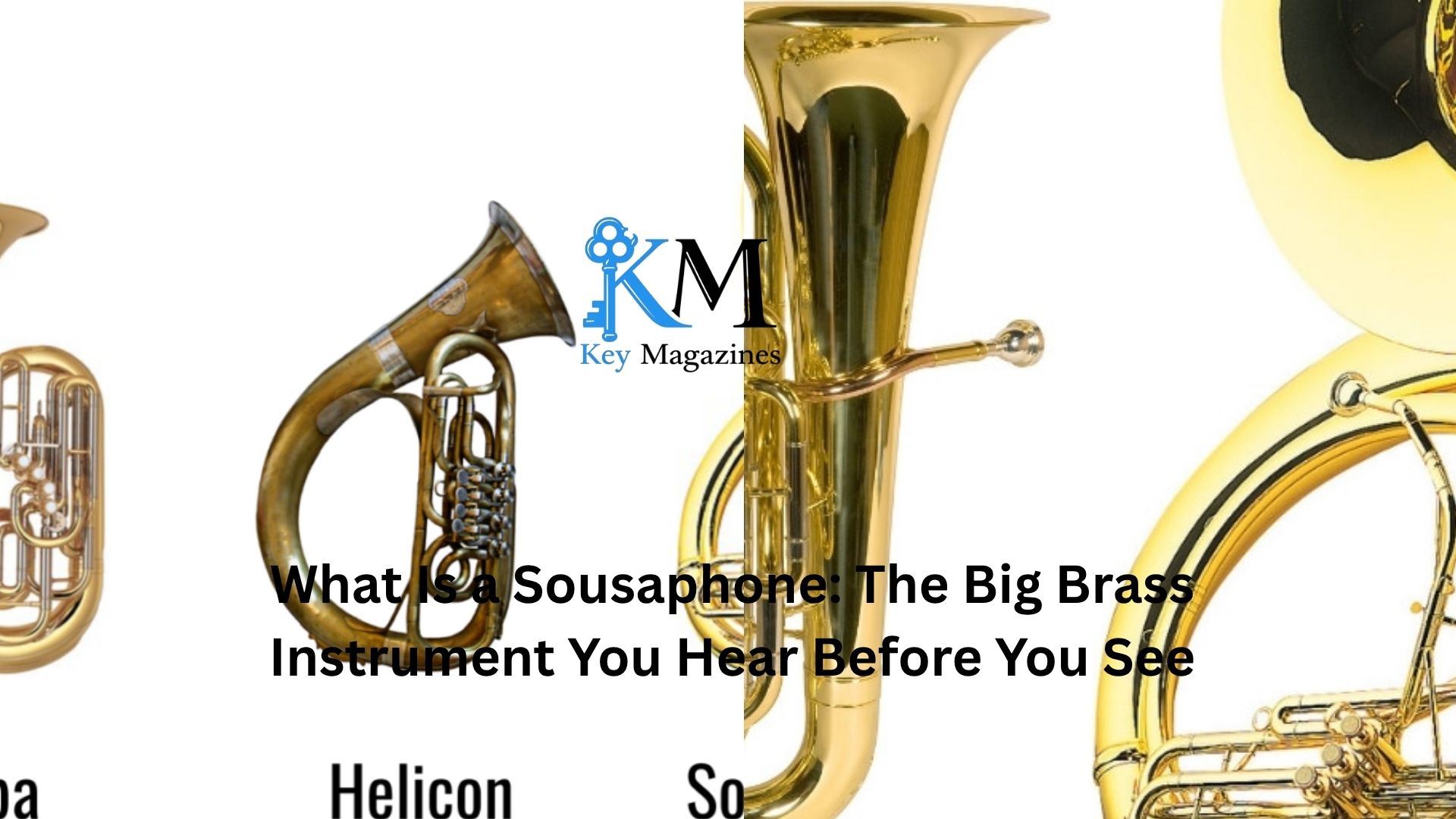
You hear it before you spot it. A deep, rolling bass line cutting through the noise of a parade, steady as a heartbeat. Then you turn your head and there it is, wrapped around someone like a gleaming metal halo. That’s the sousaphone.
It’s one of those instruments people recognize instantly, even if they don’t know the name. Big, bold, and impossible to ignore. But there’s more going on here than just size and volume.
The Sousaphone at a Glance
At its core, the sousaphone is a type of tuba. Same family, same low brass voice. The difference is in how it’s built and how it’s used.
Unlike a traditional concert tuba that sits on your lap, the sousaphone is designed to be worn. The tubing wraps around the player’s body, resting on the shoulder, with the bell pointing forward. That last part matters. A lot.
It means the sound doesn’t just float upward or get lost in a concert hall. It goes straight out to the crowd. Perfect for marching bands, street performances, and anywhere you need that low-end punch to travel.
Why It Looks the Way It Does
The design isn’t just for show. It solves a real problem.
Imagine trying to march down a street carrying a standard tuba. It’s bulky, awkward, and not exactly balanced for walking. Now picture doing that for an hour in the sun. Not fun.
The sousaphone fixes that by distributing the weight across the player’s body. The circular shape wraps around the torso, so instead of holding it, you wear it. It frees up your arms and makes movement a lot easier.
The forward-facing bell is another smart tweak. In a parade, the audience isn’t above you like in a concert hall. They’re in front, on the sidewalks. So the instrument projects sound exactly where it’s needed.
It’s a practical design that just happens to look dramatic.
A Quick Backstory
The sousaphone didn’t appear out of nowhere. It was named after John Philip Sousa, a famous American bandleader from the late 1800s. He wanted an instrument that could carry the bass line clearly in outdoor performances.
Early versions actually had bells that pointed upward. Those were called “raincatchers” because, well, they looked like they could collect rain. Eventually, the forward-facing bell became standard, and that’s the version most people know today.
Sousa’s idea was simple: make the bass louder, clearer, and more mobile. Mission accomplished.
What It Sounds Like
If you’ve ever felt music in your chest before you really heard it, that’s the kind of effect a sousaphone can have.
It produces deep, rich tones that anchor the entire band. Think of it as the foundation. Without it, everything feels a little lighter, maybe even unstable.
In a marching band, the sousaphone often carries the rhythm as much as the pitch. It locks in with the drums and keeps everyone grounded.
But it’s not just about power. A good player can make it surprisingly expressive. Smooth, warm lines in a jazz setting. Punchy, playful notes in a street band. It can be subtle when it needs to be, though let’s be honest, subtle isn’t its main job.
Where You’ll See One in Action
The most obvious place is a marching band. High school football games, college halftime shows, big parades. Anywhere there’s a line of musicians moving in formation, there’s probably a sousaphone or two holding down the low end.
But that’s not the whole story.
You’ll also find sousaphones in New Orleans-style brass bands. Picture a group playing on a street corner, people dancing nearby, the music loose and alive. The sousaphone often replaces the bass guitar in that setup, walking through the harmony with a groove you can’t ignore.
Then there are pep bands, festival groups, and even some modern fusion acts. The instrument shows up in more places than you might expect, especially when live energy matters more than polished studio sound.
How It Feels to Play One
Wearing a sousaphone is an experience. It’s not something you casually pick up.
First, there’s the weight. It can be anywhere from 10 to 25 pounds depending on the material. Not unbearable, but you feel it, especially over time.
Then there’s the balance. Once it’s properly positioned, it actually sits quite comfortably. The wraparound design does its job. But getting to that point takes practice. New players often look a bit like they’re wrestling with it.
Breathing is another piece of the puzzle. Like all brass instruments, the sousaphone relies on airflow. But because it’s so large, it takes a lot of air to keep the sound full and steady. You’re not just playing notes. You’re managing your breath constantly.
And yet, there’s something satisfying about it. You’re not tucked away in the background. You’re physically part of the sound. When the band hits a big moment, you feel like you’re driving it.
Materials and Variations
Most sousaphones are made from brass, which gives that classic bright, metallic look. But you’ll also see fiberglass versions, especially in school bands.
Why fiberglass? It’s lighter and more durable. Drop a brass instrument and you’re looking at dents and expensive repairs. Fiberglass can take a bit more abuse, which is useful when you’re dealing with large groups of students.
The trade-off is in sound. Brass generally produces a richer tone, while fiberglass can sound a bit less full. For many situations, though, the difference isn’t a dealbreaker.
There are also variations in bell size and shape. Some are wider for more projection, others a bit more compact. It depends on the setting and the kind of sound the group wants.
Sousaphone vs. Tuba: What’s the Real Difference?
It’s easy to think of the sousaphone as just a “marching tuba,” and that’s not wrong. But the differences go beyond portability.
A concert tuba is built for seated playing. It blends into an orchestra or concert band, supporting from below without drawing attention.
The sousaphone is built for visibility and projection. It’s louder, more direct, and often more rhythmic in its role.
Here’s a simple way to picture it. A tuba is like a solid, reliable engine humming under the hood. A sousaphone is that same engine, but now it’s mounted on the outside, revving where everyone can hear it.
Same roots, different jobs.
Learning Curve and Who It’s For
You don’t usually start on a sousaphone. Most players begin with smaller brass instruments like trumpet or trombone, or with a concert tuba.
Once you understand the basics of brass playing, moving to a sousaphone is more about adjusting to the size and physical demands.
It suits people who don’t mind being seen. You’re literally carrying one of the biggest instruments in the band. There’s no hiding in the back row.
At the same time, it’s not about showing off. The role is supportive. You’re there to make everyone else sound better. That balance, being both prominent and foundational, is part of what makes it interesting.
A Few Everyday Moments
Think about a local parade. Kids waving flags, floats rolling by, a marching band approaching from a distance. The melody might catch your attention, but it’s the low thump of the sousaphone that makes you feel the band getting closer.
Or a college game. The crowd’s loud, the energy is high, and the band kicks into a fight song. The sousaphones are swaying in unison, bells pointed straight at the stands, pushing that bass line right into the noise.
Even on a random street corner, a small brass band can turn heads just by starting to play. And more often than not, it’s the sousaphone that gives the music its weight.
Why It Still Matters
With all the electronic music and digital production out there, you might wonder why an instrument like this still holds its place.
Here’s the thing. Nothing quite replaces the physical presence of live sound. A speaker can reproduce bass, sure. But it doesn’t move the same way. It doesn’t breathe.
A sousaphone player is constantly shaping the sound in real time. Tiny changes in air, embouchure, timing. It’s alive in a way that’s hard to fake.
And visually, it adds something too. There’s a kind of joy in seeing a line of musicians carrying these huge, looping instruments, moving together, playing as one.
Final Thoughts
The sousaphone is more than just a big, quirky instrument. It’s a solution to a practical problem, a key part of many musical traditions, and a powerful presence in live performance.
It carries the bass, sets the pulse, and brings a kind of energy you can feel as much as hear.
Next time you hear that deep, steady line rolling through a crowd, take a second look. Somewhere in there, someone’s carrying a whole lot of brass and making it sound effortless.